
In a Crawlspace, the Hardest Thing to Bring Out Is the Full Story
Finding the water stain is rarely the problem. Bringing out where it was, what surrounded it and what still needs checking — while both hands are busy — is.
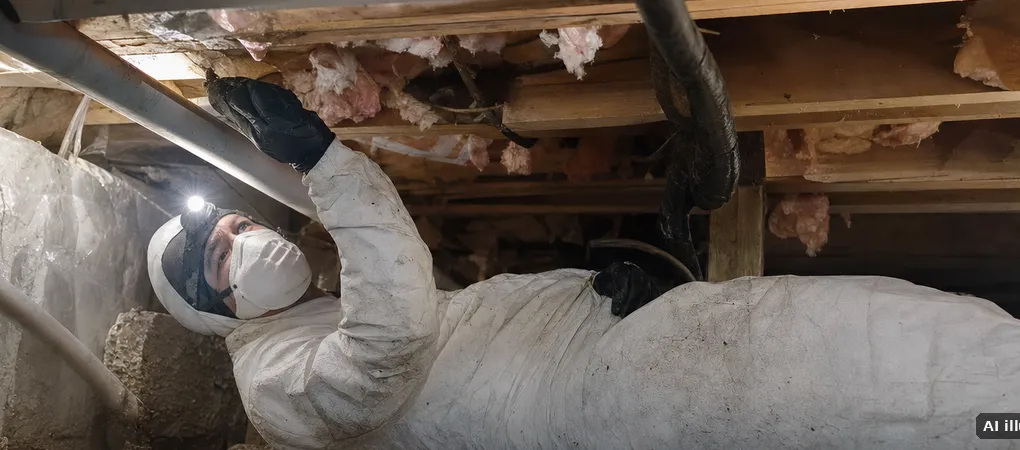
The technician in a crawlspace is working with their whole body. One hand holds them up, the other moves the light or the tool, and the space barely allows a turn. Spotting a water stain on a supply line is not the hard part. The hard part is bringing out everything around it: where along the run it was, what the insulation nearby looked like, what could not be seen past the duct, and what still needs checking.
Stopping to pull out a phone means breaking the motion that got them there. So the record often gets rebuilt later, from memory and a handful of photos taken at whatever angle was possible.
Why the homeowner struggles to follow
The homeowner almost never goes into the crawlspace. They meet the problem as a few pictures and a quote. They cannot tell where the stain is relative to the kitchen above, whether the cause is confirmed or suspected, or why the scope includes the items it does. The explanation carries the whole weight, and it rests on what the technician remembers at the end of the job.
That gap shows up again when someone comes back to do the work, and again when the finished repair has to be compared with the original problem.
What a useful record would look like
The goal is not more video. Nobody wants to watch forty minutes of a crawl. A useful record is organised around issues:
- Where: a zone and a location someone else can find again (“east side, second section of supply line”).
- What was seen: the observation, tied to the matching clip or photo.
- What was checked: any inspection or measurement the technician actually performed; “not measured” when it was not.
- What is still open: the suspected cause, marked as unconfirmed.
- What could not be seen: areas blocked from view, stated plainly.
Each issue gets a number. The quote cites the number and states what is and is not included. After the repair, the same location is checked again, and the before and after sit side by side.
What we are building, and what has to be proven first
We are developing a wearable AI vest, HA-VEST01, designed to let field staff capture short spoken observations and permitted images while they work, and to attach them to the job. A trained person then reviews and organises them into an issue list before anything reaches the homeowner. The product is in prototype iteration and pilot preparation; none of this is a finished capability.
The first question is not about software. It is whether a body-worn camera can see anything useful while someone is lying prone or crawling, or whether it mostly records the ground. It is also whether the vest catches on framing, runs too hot or makes cleanup harder. If the wearable gets in the way of the work, better software cannot make up for it. That is why the plan starts with movement and camera-position tests in a controlled space, before any real job.
The judgement stays with the professional. Deciding where to look, what to test and what the problem is remains the technician’s job. The record’s job is to carry that judgement out of the crawlspace with its context intact.
An invitation
If you run crawlspace repair, encapsulation or inspection work, send us one de-identified report and mark the details that are hardest to capture while you are under the house. If it looks like a fit, the next step is a controlled wearability test, not a sales call.