
The Evidence Tax Behind AI Agents
AI agents are reaching small business. The hard part is paying the Evidence Tax: motion, cleanup, and review before memory becomes useful on real jobs.
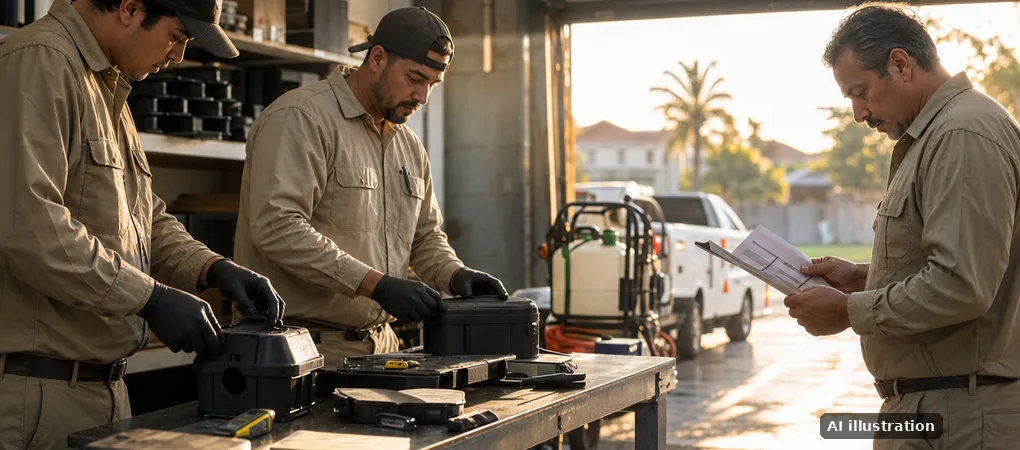
AI agents are no longer the scarce part.
The Small Business & Entrepreneurship Council recently framed agents as moving into the small business mainstream. Fair. But in pest control, the hard problem is not whether an agent can draft a report. It is whether the visit left enough real evidence for the agent to work from.
Name the problem: the Evidence Tax
The Bureau of Labor Statistics Occupational Outlook Handbook, accessed October 2026, describes pest control work as inspection, treatment choice, measuring, estimating, and applying controls. That is a field judgment chain, not a typing task.
The Evidence Tax has three parts: motion, cleaning, and review. Every capture method pays that tax differently.
- Motion: What must the worker stop doing to record the work?
- Cleaning: What has to be wiped, uploaded, named, clipped, or matched later?
- Review: What still needs a trained human before it becomes a customer-facing record?
Phone in hand
A phone is enough for a clean exterior treatment, a bait station photo, or a simple renewal note. It is familiar, cheap, and already tied to the job app.
But it misses the running explanation: what the customer said in their words, why the tech chose one treatment path, what looked borderline but not yet serious. The cost is small stops all day: gloves off, screen wiped, photo found, note typed after the smell of the place is already gone.
Pick the last return pest customer.
Without opening the file, what did the tech say about activity level, access, odor, pets, and homeowner concern? Now open the report. That gap is the Evidence Tax.
Clip-on or head-worn recorder
A small recorder is enough when the job is mostly narration: attic inspection, crawl route, termite explanation, or end-of-visit summary. It protects the worker from reconstructing a half-hour walk-through from memory.
It misses the visual proof and instrument readings unless someone pairs files later. The cleaning cost moves to charging, consent practice, dirty clips, wind noise, and reviewing long audio chunks.
Wearable AI vest
A wearable AI vest is worth testing when the worker’s hands, eyes, and route all matter: crawlspace inspection, multi-room infestation mapping, restoration walk-through, or a job where the report has to explain sequence. Hearit.ai HA-VEST01 is still in prototype iteration and pilot preparation, designed to link permitted on-site voice and optional images to the job for professional review.
It is not worth it for a five-minute exterior spray, a strict uniform environment, heavy heat, or any team that has not settled consent and cleaning rules. The vest pays the Evidence Tax upfront: fit, donning, power, wipe-down, and review discipline.
Dedicated instruments
Moisture meters, thermal cameras, bait-station scanners, and chemical logs are enough when the proof is numeric or regulated. They create defensible facts.
But instruments rarely explain the human context. They do not remember that the customer was worried about a nursery, that the gate sticks, or that the senior tech noticed a pattern from three visits ago.
The economic point is simple: software depreciates when it stores thin records; memory compounds when each visit makes the next visit clearer.
“The useful question is not which device records more. It is which record the business can trust next month.”
For a pilot, start with one de-identified inspection report and mark the fields your team always struggles to fill. The agent can help only after the work keeps a better memory.