
The Field Memory Gap AI Agents Still Can’t Cross
AI agents can build a website fast. HVAC shops need something harder: field memory from the visit, report, and next technician handoff, preserved with consent.
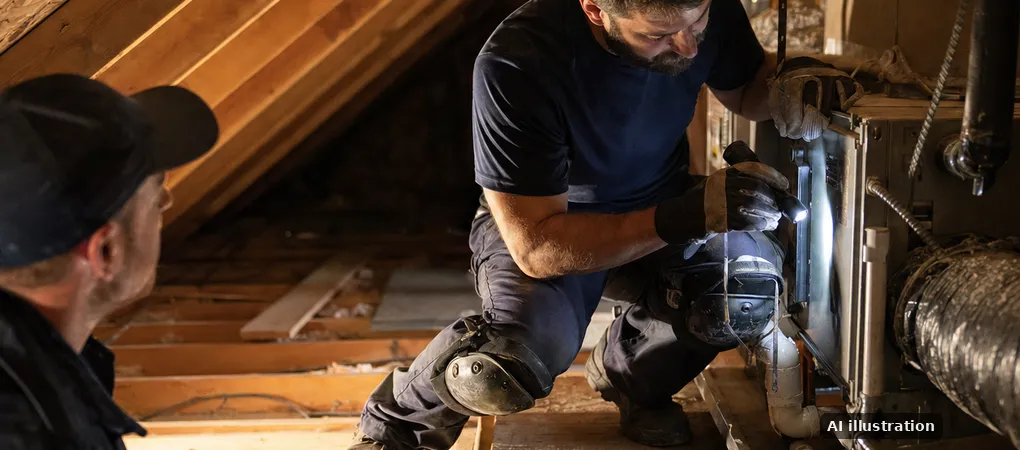
A near-instant AI website and an HVAC work order that says “unit checked, customer advised” can live inside the same small business.
That tension matters. BigGo Finance recently pointed to OpenAI expanding AI agent training for small business owners, including a demo where a website comes together very quickly. Good. Owners should get faster tools.
But the hard part of an HVAC company is not only the public face of the business. It is the version of the job that existed at the unit, in the hallway, at the customer’s door, in the technician’s explanation, and then got compressed into a thin note.
Name the problem: field memory decay.
The case: one no-heat visit, three versions of reality
Take a common winter no-heat job. The first technician finds the system running, then not running, then running again. The homeowner explains that the problem happens after the system has been off for a while.
At the equipment, the technician checks power, listens to the inducer, notices water near a drain line, explains a likely sequence to the homeowner, and decides what should be watched if the issue returns. Some of that is hard fact. Some of it is judgment.
- At the site: the work is rich, noisy, physical, and full of context.
- In the report: the work becomes a few typed phrases, often after the van has moved on.
- At the next visit: the second technician starts from the report, not from the first technician’s actual reasoning.
This is the handoff that breaks: site → report → next visit. Not because technicians are careless. Because human memory was never designed to be the data pipeline for skilled work after a long day.
The designed version of the business says every job is documented. The shipped version says the real explanation lived in the truck, in the attic, beside the furnace, and partly in one person’s head.
“AI agents do not need more confidence. They need version control for field reality.”
The agent can draft. It still needs the visit
The current AI story for small business is useful, but incomplete. An agent can make a website, summarize policy, draft a proposal, clean up a message, or prepare a document. That helps the office move faster.
But HVAC work is not born in the office. It is born when a technician hears the customer describe the pattern, checks the unit, says what they see, rules out the obvious, and chooses what to do next.
If that spoken work never becomes usable memory, the agent is reasoning from a shadow. It may write clean sentences. It may format the report. It may sound organized. But it does not know what was actually observed unless the business has a way to preserve it.
That is why the next category is not another admin screen. It is the Field Voice Data Layer: the consented, work-only spoken record from the job, structured so AI can search it, connect it to the work order, and prepare it for human review.
Pick the last return visit on a system your team had already touched.
Before opening the software, ask: what did the first tech actually say at the unit, what did the customer say in their own words, and what made it into the report? The gap is your field memory decay.
Why memory disappears in skilled work
There is a human reason this keeps happening. Technicians do not experience a job as a form. They experience it as motion: climb, listen, test, explain, decide, clean up, move.
The report asks for a neat sequence after the fact. But cognition does not store every observation as a perfect checklist. People remember meaning, not transcript-quality detail.
- The customer’s words fade: “only after it sits overnight” becomes “intermittent issue.”
- The technician’s judgment shrinks: “inducer sounded strained at startup but stabilized” becomes “checked operation.”
- The next visit gets weaker: the second technician sees the note, not the reasoning behind the note.
Senior technicians carry years of pattern recognition. A shop feels the value of that every day. The risk is that the pattern recognition leaves as private memory instead of becoming shared work memory.
This is not surveillance. Surveillance asks, “What was the worker doing?” Field memory asks, “What did the work require, what was observed, what was explained, and what should the next person know?”
The wearable approach: AI gets closer to the work
At GMIC AI, the thesis behind Hearit.ai HA-MIC01 is simple: it is not recording hardware. It is the jobsite ear for Physical AI, built around the spoken work that happens when hands are busy and the best note would be impossible to type.
In parallel, Hearit.ai HA-VEST01 is being explored as a wearable work garment for home and property service environments. The current work is still prototype iteration and pilot preparation: garment prototypes and fit photos exist, the V4.13 structure uses a two-layer design with module mounts, cable routing, and split power pockets, and the plan is to validate how permitted on-site voice and optional images can link to a job for professional review.
The important phrase is professional review. Humans decide. Humans diagnose. AI can help organize the memory, surface prior context, and prepare draft material, but the technician remains the expert.
Consent comes first. Work-only memory must be transparent, worker-controlled, and tied to technician dignity. A good system should reduce reconstruction, not turn the field team into subjects of suspicion.
What this means for AI agents in trades
OpenAI training for small business owners is a sign of where the market is going. More owners will know how to ask agents for drafts, summaries, websites, forms, campaigns, and reports. That skill will spread.
Then the harder question arrives: what is the agent allowed to know?
- If it only knows the office record, it inherits the office record’s omissions.
- If it only knows typed notes, it inherits what tired people had time to type.
- If it knows the permitted spoken record from the visit, it can help preserve the judgment that normally disappears between jobs.
Field-service SaaS already owns much of the workflow: schedule, dispatch, job status, invoice, customer record. AI owns more of the reasoning. The open gap is the real-world input layer that connects physical work to enterprise memory without asking the technician to rebuild the day at a keyboard.
The first Physical AI in home services will not arrive as a robot replacing skilled judgment. It will ride with human workers as consented work memory. The technician becomes the sensor because the technician is already where reality happens.
The transferable principle
The no-heat case is not really about one furnace. It is about the crack between the version of the business designed on paper and the version shipped in the field.
A shop does not need AI that only makes the office look faster. It needs AI that can remember what the team already learned at the site, carry that memory into the report, and make it available at the next visit.
For pilot work, the useful starting artifact is modest: share a de-identified work order or report and mark the fields your team struggles to complete from memory. The pattern in those blank spaces will say more than a polished demo.
AI agents can build the small business front door faster now. The next fight is whether they can remember what happened after the technician walked through the customer’s.