
Phone, Vest, Meter: Capturing HVAC Work
AI helps small shops, but HVAC work needs the right field input. Compare phones, wearables, vests, and instruments before trialing your next workflow.
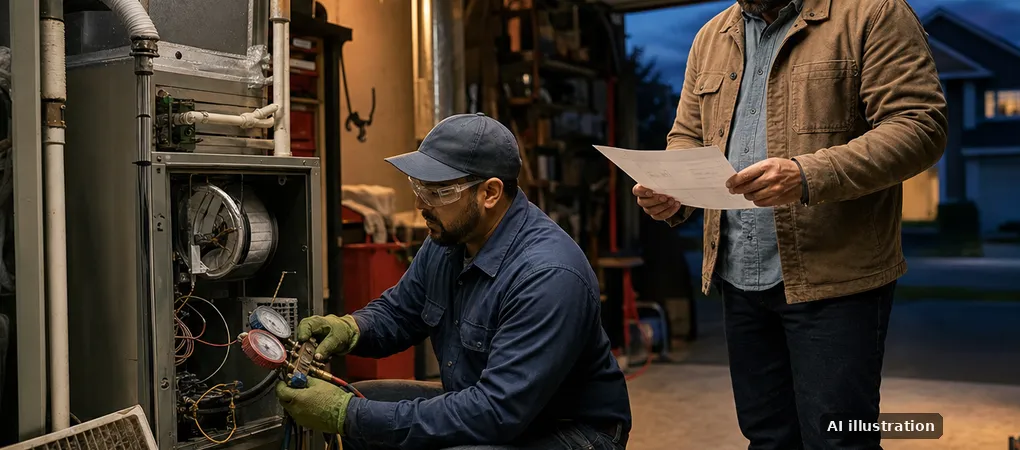
The van is back at 6:40 p.m. The job note says, “checked unit, advised customer,” and tomorrow morning someone will ask what was actually advised.
You know the rest. The tech remembers most of it. The homeowner remembers the one sentence that matters to them. The office has a work order that looks complete until it has to support a return visit, an estimate, or a warranty question.
Facebook’s recent small-business AI headline says many owners feel more productive with AI, but still need guidance. That sounds right. The software got clever fast. The guidance did not.
For an HVAC shop, the guidance is not “buy AI.” That is charmingly unhelpful. The useful question is: which part of the service visit should become machine-readable, and what is the least awkward way to catch it?
AI does not need more ambition in the back office. It needs better field memory from the moment work happens.
Take the ordinary pattern. A tech is at a split system. The capacitor is bad, the coil is dirty, static pressure is suspicious, and the customer mentions that the back bedroom has been uncomfortable since the remodel.
Four capture methods can help. None is magic. Each has a place, and each taxes the worker in a different currency: motion, cleaning, and review time.
1. Phone in hand
The phone is enough when the task is visual, brief, and obvious. A model plate. A cracked drain pan. A thermostat wiring photo before touching anything. It is also enough when the shop only needs proof that a specific condition existed at the visit.
What it does not catch is the chain of judgment. Why the tech checked static pressure after hearing the customer describe the back bedroom. Which option the customer rejected. What the tech said in plain language before leaving.
- Motion cost: gloves off, unlock screen, aim, wipe lens, pocket it again. Small interruptions, repeated all day.
- Cleaning cost: phones hate condensate, insulation dust, attic grime, and whatever is on a crawlspace glove. Workers become amateur device custodians.
- Review cost: photos pile up. Someone later decides which image belongs to which sentence, which is a fine use of human life if you enjoy archaeology.
2. Clip-on or head-worn audio device
Hands-free audio is enough when the main missing asset is the spoken explanation. It catches the tech narrating findings, walking through options, and confirming customer details without typing after a long day.
This is where Hearit.ai HA-MIC01 sits: a wearable AI microphone built as the jobsite input for the Field Voice Data Layer, turning permitted work speech into service reports, work orders, and searchable Frontline Work Memory. Not employee surveillance. Not a replacement for the workflow system. The point is to carry the field reality into the system the team already runs.
- Motion cost: low during the visit if the device is placed correctly. The cost moves to start-of-day pairing, charging discipline, and remembering to mark work-only recording boundaries.
- Cleaning cost: microphone grilles, clips, and windscreens need a routine. HVAC dust is patient. It gets everywhere.
- Review cost: lower than raw photos for narrative, but not zero. Professional review still matters, especially before customer-facing documents or technical conclusions.
Pick the last return customer. Without opening the system, what did your tech say about comfort, access, and customer preference last visit?
Now open the work order. The distance between those two answers is the guidance problem AI cannot solve from the office alone.
3. Wearable AI vest
The vest is the tempting answer right now because everyone wants AI to have more context. Voice plus optional images, tied to a job, could reduce reconstruction work on complex visits. That is the theory worth testing.
It is designed for the visits where the worker’s body is already part of the documentation problem: attic access, roof units, crawlspace inspection, restoration walks, long diagnostic paths, multi-room plumbing work. If the tech is moving, pointing, explaining, and discovering in sequence, a vest may carry more context than a phone or clip-on audio alone.
But it is not worth it for every job. A clean filter change, a quick capacitor replacement, or a simple thermostat swap does not need a wearable command center. That would be a costume change, not an operating improvement.
- Motion cost: higher than a clip-on. Pockets, cable routing, module placement, heat, kneeling, ladder work, and seat belts all matter. If the worker fights the garment, the data loses.
- Cleaning cost: higher and still to be proven in real routines. Dust, sweat, insulation, and jobsite residue create a garment problem, not just an electronics problem.
- Review cost: potentially richer, but richer can mean heavier. More context creates more decisions about privacy, relevance, and what belongs in the report.
Our vest work is still prototype and pilot preparation: structural design, module mounts, cable routing, split power pockets, fit iteration. Capabilities should be read as designed to support, not proven at scale. The pilot question is narrow: can permitted on-site voice and optional images help technicians reconstruct less while teams prepare reports for professional review?
4. Dedicated instruments
Meters are enough when the field fact is numeric or categorical. Manifold readings. Combustion analysis. Temperature split. Static pressure. Leak detection. These are not replaced by AI narration, and sensible shops should be suspicious of anyone suggesting otherwise.
What instruments do not catch is context. The gauge can tell you a reading. It cannot tell you the homeowner said the addition was done after the original system was sized, or that the senior tech chose not to recommend a certain repair because access would create another issue.
- Motion cost: instrument setup, probes, hoses, calibration checks, and safe handling. The work is real, and it should stay real.
- Cleaning cost: probes, hoses, cases, filters, and sensor care. Dirty tools make dirty records.
- Review cost: readings still need interpretation. A number without the spoken reason around it becomes a lonely little artifact in the file.
The operator’s rule: match the input to the job
The consensus says small businesses need more AI tools. Maybe. But the HVAC shop first needs a policy for which real-world inputs deserve capture, and at what burden on the technician.
A phone is cheap until the tech has to stop working to feed it. A vest is powerful-looking until it slows a simple visit. A meter is authoritative until its number gets separated from the reason the reading was taken. Audio is natural until consent and review rules are vague.
The economic point is simple. Tools depreciate. Work memory compounds. The shop that can search what was checked, said, declined, explained, and decided has an asset that improves dispatch, training, warranty handling, and handoff quality over time.
That asset is not created by asking tired technicians to re-type the day at night. It is created by choosing the right field input for the work in front of them, with consent, work-only boundaries, and respect for the person wearing the device.
For a pilot, the useful starting point is not a shopping list. Share a de-identified work order or report and mark the fields your team finds hardest to capture: customer preference, access notes, diagnostic sequence, equipment condition, or the senior tech’s reasoning.
AI productivity in the trades will not come from making the back office sound smarter. It will come from giving the business a memory that starts while the work is still warm.