
The Receptionist Math AI Agents Make Obvious
The receptionist vs AI agent math is no longer theory: real payroll, $200/month AI, and why HVAC shops need voice memory from office to jobsite.
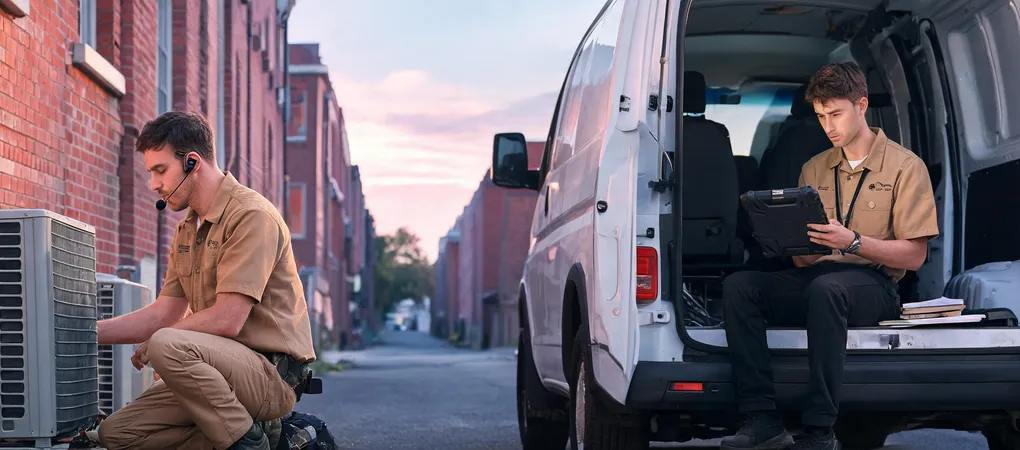
It is 5:12 p.m., your last tech is still on a rooftop, and the office note says: “customer says unit acting weird again.” That sentence is how a shop pays for the same diagnosis twice.
Entrepreneur is right to point out that small business owners are starting to manage teams of AI agents. But for HVAC, plumbing, electrical, and other field trades, the first useful agent is not a clever chatbot. It is the one that captures what was actually said.
The real cost of a human receptionist
A good receptionist is not “just someone answering phones.” They calm customers, collect details, protect the owner’s time, and keep the schedule from turning into soup.
Respect the role. Then do the math.
- Wages: A full-time receptionist usually lands around $30,000-$36,000 in base pay, depending on market and experience. The U.S. Bureau of Labor Statistics puts receptionists and information clerks in the roughly $18-$19/hour range nationally.
- Employer load: Payroll taxes, workers’ comp, basic benefits, and administrative cost add real dollars. A practical small-business estimate is another $3,500-$6,000 per year.
- Training: Someone has to teach the system, the service area, the difference between “no heat” and “weak airflow,” and which senior tech can handle the strange boiler nobody else wants.
- Sick days and PTO: The phones do not get simpler because a person has the flu. Coverage becomes the owner, the dispatcher, or whoever is closest to the ringing desk.
- Turnover: When the front desk changes, the memory changes. Customer preferences, building quirks, warranty details, and “don’t send that tech there again” context all get thinner.
That is how a $30,000 job becomes a $35,000-$45,000 annual operating cost. Not because people are expensive. Because context is expensive.
What AI actually does for $200 a month
An AI phone agent at $100-$300 per month is not a better human. It is a different cost structure.
At $200/month, you are paying $2,400/year for something that works all day, every day, does not call in sick, and can handle bursty call volume without making the next customer wait behind a long explanation about a thermostat.
- It captures the customer’s words: address, equipment type, symptoms, urgency, access notes, pets, gate codes, landlord details.
- It structures the conversation: not just a transcript, but clean job context your team can search later.
- It hands off cleanly: the office sees what was said, not a rushed version typed between three other tasks.
- It scales: ten conversations at once is not ten new hires. It is capacity that wakes up when the day gets loud.
This is where Telalive fits: customer phone conversations become searchable customer memory, not scraps of phrasing trapped in somebody’s head.
Add up your receptionist’s wages, employer costs, sick-day coverage, training, and turnover reset. What is the real number?
Now compare that with $2,400/year for a voice agent that preserves what customers said in their words.
The math that makes the decision obvious
Human receptionist: $35,000-$45,000/year.
AI phone agent: $1,200-$3,600/year. At the common $200/month level, $2,400/year.
The spread is $32,600-$42,600 per year before you count the difference between 40 hours a week and 8,760 hours a year.
But the bigger point is not payroll. The bigger point is memory.
“AI agents are only as useful as the business memory they can hear.”
IBISWorld has sized the U.S. HVAC contractor market around $159 billion. The Bureau of Labor Statistics counts roughly 425,000 HVACR mechanics and installers. Across about 120,000 contractors, the same problem repeats: the workflow software is waiting for humans to type reality after the work already happened.
That is the invisible problem: voice goes in, memory leaks out.
The receptionist is only one end of the pipe
The office hears the customer. The field hears the machine.
That is why Hearit.ai HA-MIC01 matters. On the roof, in the crawlspace, beside the air handler, it lets the technician speak the diagnosis while hands are still on the work, then turns that spoken detail into service reports, work orders, and searchable Frontline Work Memory.
Not surveillance. Not a cheap recorder. Not a replacement for ServiceTitan, Housecall Pro, Jobber, or Dynamics. Those systems own workflow. They still need clean field reality.
The AI agent trend is real, but the winners will not be the shops with the most agents. They will be the shops where agents have the best memory: what the customer said, what the tech found, what fixed it, and what should never be diagnosed from scratch again.
The receptionist math is obvious. The deeper shift is sharper: the front desk is becoming an input layer, and the jobsite needs an ear.
From AI phone agents to custom hardware — we’ve got you covered.