
Why Your Recorded Voice Doesn’t Sound Like You
Why your recorded voice feels unfamiliar — and why real-world AI must start with better listening, not just better language models.
Most people have had this moment:
You hear your own voice in a recording, and your first reaction is almost physical.
Is that really me?
It sounds thinner. Sharper. Less warm. Less certain.
The uncomfortable truth is that the recording is not lying.
The voice you hear when you speak is not the same voice everyone else hears.
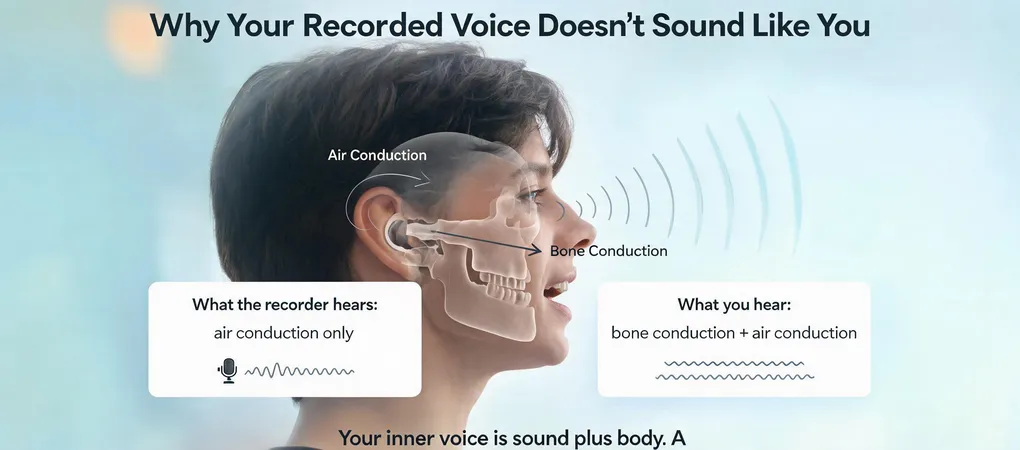
When other people hear you, they hear your voice through air conduction. Sound leaves your mouth, travels through the air, and enters their ears.
But when you hear yourself, there is another path involved: bone conduction.
Your skull, jaw, and facial bones carry vibration directly to your inner ear. That physical path changes the sound. It softens some frequencies. It adds warmth. It gives your own voice more depth than the outside world actually receives.
In other words:
The voice in your head is not just sound. It is sound plus body.
That gap is why hearing your own recorded voice can feel strangely exposing. Psychologists have called this reaction “voice confrontation.” You are not only hearing a sound. You are meeting an external version of yourself that your brain did not fully approve.
This matters far beyond personal embarrassment.
Voice is one of the most human signals we have.
It carries hesitation, stress, confidence, fatigue, emotion, intent, and context. It is not just information. It is presence.
As AI moves from screens into the physical world, the question is no longer only:
Can machines understand words?
The deeper question is:
Can machines understand people in the real world?
That starts with better listening.
Not just clean audio. Not just transcription. Not just voice commands.
But the ability to capture the real human signal in motion — at work, in conversation, under noise, pressure, and context.
This is why wearable AI audio matters.
A microphone is not just an input device anymore.
It can become a bridge between the physical world and intelligent systems.
The first step toward ambient AI is not a smarter chatbot.
It is a better ear.
At GMIC AI, we are building wearable AI audio systems for the real world — because the next interface is not another screen. It is the human voice, captured in context.